News I iCET Successfully Holds Mid-Term Meeting for Phase III of the “BestECV – Optimal Electric Commercial Vehicles” Project
On June 6, 2024, the Innovation Center for Energy and Transportation (iCET) successfully convened the mid-term meeting for Phase III of the “BestECV – Optimal Electric Commercial Vehicles” project. More than ten experts from universities, enterprises, industry organizations, and research institutions participated in the meeting both online and offline. iCET presented a summary of Phase III research progress and field study results, gathered expert feedback on the project’s advancement, and engaged in in-depth discussions on the next steps.
Between January and April 2024, China recorded approximately 960,000 commercial vehicle sales, of which 136,000 were new energy commercial vehicles, bringing the penetration rate to 14%. As the market continues to grow, challenges such as rapid technological iteration, scenario-based product development, scaling up production, and cost reduction have emerged. Given that commercial vehicles ultimately function as productive assets, maximizing economic value is the central concern for users. Therefore, increasing revenue and reducing costs across the full life cycle—thereby improving the economic value of new energy commercial vehicles in various operational scenarios—is key to further increasing market penetration.
To better support the electrification transition in the commercial vehicle sector, iCET launched the BestECV project in 2020 with support from the Energy Foundation. The project established a comprehensive, user-friendly online assessment system—BestECV™—which includes a database of electric commercial vehicle models, enabling cost–benefit and emission-reduction analysis, scenario-based electrification assessments, and the development of tailored solutions for specific use cases.
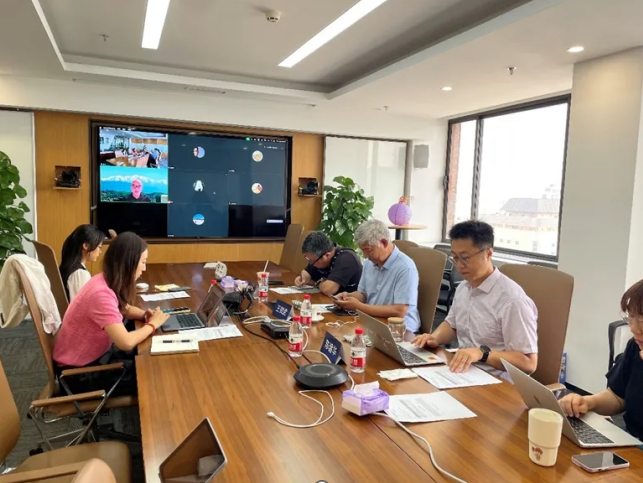
Mid-term Meeting for Phase III of the “BestECV – Optimal Electric Commercial Vehicles” Project
During the meeting, Ms. Wang Wenwen, Project Manager at iCET and Lead of the BestECV project, presented an overview of Phase III progress, which focuses on the following areas:
1. Expanding the Promotion Committee and Partnership Alliance
Bringing in more stakeholders from government agencies, research institutions, and industry to support technical route design and subsequent project development.
2. Multi-dimensional Market Analysis
Conducting spatial, temporal, and scenario-based analyses of the new energy commercial vehicle market based on national market data.
3. Continuous Database Enhancement
Updating the electric commercial vehicle database and improving BestECV’s cost–benefit and environmental impact modules. Through field research, the team assessed fleet needs across various scenarios and developed targeted solution toolkits.
Ms. Wang presented key findings from scenario-based analyses covering municipal sanitation, logistics transportation, and port drayage, based on market data, interviews, and field research. The project team conducted meetings with OEMs, research institutes, universities, and logistics companies, and carried out field studies in cities including Beijing, Shanghai, and Tangshan. These insights provided critical references for designing scenario-specific solution toolkits and selecting appropriate parameters.
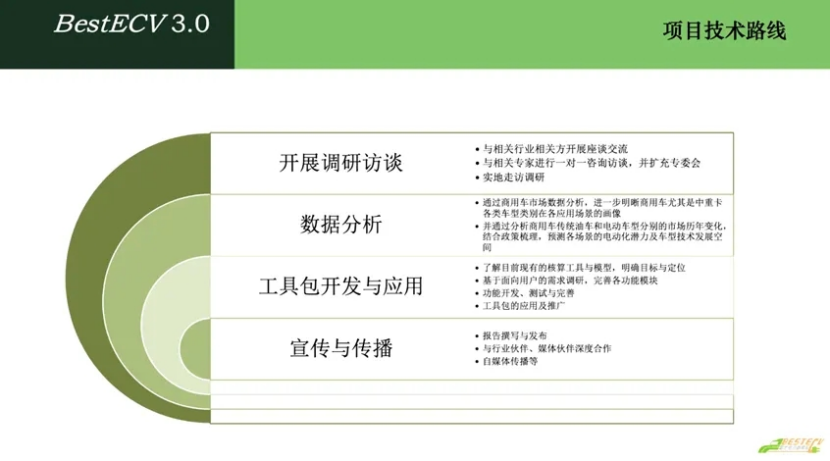
Phase III Technical Roadmap
Experts attending the meeting provided feedback and acknowledged the substantial progress achieved. They also offered constructive suggestions for the next phase. Contributing experts included Dou Gang (China Electrotechnical Society EV Committee), Hao Chunxiao (Vehicle Emission Control Center, Chinese Research Academy of Environmental Sciences), Jia Lijie (Chief Engineer, CATARC Data Co., Ltd.), Wang Hewu (Director, Zero-Carbon Transportation Research Center, Institute for Carbon Neutrality, Tsinghua University), and Xie Haiming (Director, Shenzhen XIELI Innovation Center), listed in alphabetical order.
In closing remarks, Chen Jianhua, Senior Program Officer of the Energy Foundation’s Transportation Program, thanked the project team and summarized expert feedback. He emphasized that as demand for new energy commercial vehicles continues to rise, the project’s research outcomes hold significant real-world value. He encouraged the team to focus more deeply on representative, scalable scenarios in the next stage, refine solution toolkits, and enhance the visibility and impact of project deliverables.
Dr. An Feng, Honorary Director of iCET’s Advisory Committee, reaffirmed that the project team would incorporate expert recommendations into the next phase by optimizing the technical roadmap, expanding research coverage across additional cities and scenarios, and maintaining close communication with the expert committee to ensure the successful advancement of the project.