News I iCET Conducts Research Visit to Chengdu International Railway Port
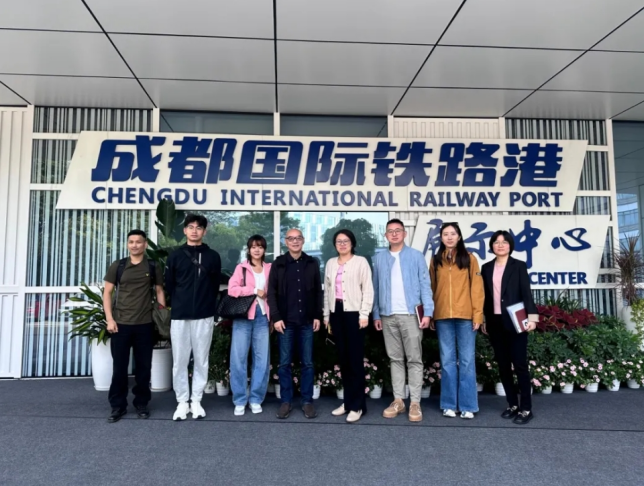
On October 23, 2024, the Innovation Center for Energy and Transportation(iCET) conducted a research and exchange visit to the Chengdu International Railway Port. The visit aimed to gain a deeper understanding of the real-world application of new energy vehicles in port operation scenarios—focusing on technical challenges, operational needs, and relevant policy requirements. The insights will support further promotion of new energy technologies in the transportation sector and provide data-driven recommendations for policymakers and enterprises.
The delegation included Dr. An Feng, Honorary Executive Director of iCET, along with members of the research team. Leaders from the Chengdu International Railway Port Administrative Committee and Investment & Development Co., Ltd., as well as graduate students from the School of Transportation and Logistics at Southwest Jiaotong University, also joined the exchange.
Officials from the Chengdu International Railway Port provided an overview of its development. Historically relying on the steel industry as a key economic pillar, Qingbaijiang District began seeking new growth pathways following adjustments to national industrial policies. In 2003, it was designated as one of China’s 18 national container center stations. After site selection and planning, the railway port was established and officially put into operation in 2010—the same year the first China-Europe Railway Express train departed from the port.
Photo: Scene from the research and exchange meeting
In terms of new energy transition, the Chengdu International Railway Port is actively exploring hydrogen energy deployment within the port area. Plans include gradually replacing existing transport vehicles with hydrogen-powered autonomous container trucks, as well as launching low-altitude logistics services to support the China-Europe Railway Express. However, as an inland port, it currently faces insufficient incentives to accelerate the energy transition. With its core mission of serving the local economy, the port is primarily focused on regional development and investment attraction, lacking strong policy drivers and sustained demand from multinational enterprises.
Dr. An Feng highlighted that railway ports, as critical logistics hubs, hold significant potential for advancing the new energy transition. He praised the Chengdu International Railway Port’s forward-looking vision in green logistics and intelligent transportation. Dr. An emphasized that port transformation requires not only technological innovation but also stronger policy support, market mechanisms, and engagement from multinational companies. By enhancing multi-stakeholder collaboration and integrating diverse resources, the Chengdu International Railway Port can explore and advance innovative solutions in green logistics and smart mobility, contributing to broader sustainable development goals.